
You’ve seen the futuristic videos—plastic melting into intricate shapes, layer by layer, until a fully formed object appears. 3D printing is no longer science fiction, and whether you’re a hobbyist, engineer, or entrepreneur, understanding the different 3D printer types is essential to choosing the right machine for your needs. With a flood of models on the market, from budget desktop units to industrial powerhouses, it’s easy to feel overwhelmed. The key lies in knowing how each type works, what materials they use, and which applications they excel in.
Not all 3D printers are created equal. The technology behind them varies dramatically, affecting print quality, speed, cost, and material options. Some are perfect for detailed miniatures, others for functional prototypes or even end-use metal parts. This guide breaks down the major 3D printer types, explains their core technologies, and helps you match the right one to your project goals. No fluff, just clear, actionable insights.
Fused Deposition Modeling (FDM)
The most common and accessible type of 3D printer, FDM is ideal for beginners and makers who want reliable, low-cost prints.
How FDM Works
A spool of thermoplastic filament, like PLA or ABS, feeds into a heated nozzle. The printer melts the material and extrudes it layer by layer onto a build plate. The nozzle moves precisely in X, Y, and Z axes, building the object from the bottom up. Once a layer cools and solidifies, the next one is added.
This process is straightforward, making FDM printers affordable and easy to maintain. They’re widely used for prototyping, educational models, and DIY projects.
Best Materials for FDM
- PLA: Easy to print, biodegradable, great for beginners
- ABS: Durable and heat-resistant, but requires enclosure
- PETG: Combines strength and ease of use
- TPU: Flexible filament for rubber-like parts
- Nylon: Strong and wear-resistant, but hygroscopic
Pro Tip: Store filament in a dry box, as moisture ruins print quality.
Common FDM Issues and Fixes
- Warping: Use a heated bed and adhesive like glue stick or tape
- Stringing: Adjust retraction settings and nozzle temperature
- Layer Shift: Check belt tension and ensure a stable power supply
- Poor Bed Adhesion: Level the bed and clean it with isopropyl alcohol
FDM printers offer the best value for money but trade off some precision for affordability.
Stereolithography (SLA)
SLA printers deliver high detail and smooth surface finishes, making them ideal for miniatures, jewelry, and dental models.
How SLA Works
Instead of melting plastic, SLA uses a UV laser to cure liquid resin layer by layer. The build platform dips into a resin tank, and the laser traces the cross-section of the model, hardening the photopolymer where it strikes. After each layer, the platform lifts slightly, and the process repeats.
Because the laser can focus on extremely fine points, SLA achieves resolutions as low as 25 microns, much finer than most FDM printers.
Resin Types and Uses
- Standard Resin: Good for visual models, brittle under stress
- Tough Resin: Simulates ABS-like durability
- Flexible Resin: For rubber-like parts, less elastic than TPU
- Castable Resin: Burns out cleanly for jewelry casting
- Dental Resin: Biocompatible, used in medical applications
Warning: Resin is messy and toxic, so always wear gloves and work in a ventilated area.
Post-Processing Steps
SLA prints require more cleanup than FDM:
1. Wash: Soak in isopropyl alcohol (IPA) to remove uncured resin
2. Cure: Expose to UV light to fully harden the print
3. Remove Supports: Carefully cut off support structures with flush cutters
Despite the extra steps, SLA’s precision makes it a favorite for detailed work.
Digital Light Processing (DLP)

DLP is a close cousin of SLA but uses a digital projector instead of a laser.
DLP vs. SLA: Key Differences
- Light Source: DLP uses a pixelated UV projector; SLA uses a focused laser
- Speed: DLP cures entire layers at once, often faster than SLA
- Resolution: Limited by projector pixel size, such as 720p or 1080p
- Image Quality: Slight pixelation at edges, but generally high detail
DLP is excellent for batch printing small, detailed parts like hearing aids or figurines.
Ideal Applications for DLP
- Jewelry Prototyping: High precision for intricate designs
- Dental Models: Accurate fits for crowns and aligners
- Miniature Production: Popular in tabletop gaming communities
Because DLP cures full layers at once, print time depends more on layer count than geometry complexity.
Selective Laser Sintering (SLS)
SLS is a professional-grade technology that uses laser heat to fuse powdered materials.
How SLS Works
A thin layer of powder, usually nylon, spreads across the build platform. A CO₂ laser scans the cross-section, sintering (fusing) the powder without fully melting it. The platform lowers, a new layer of powder is applied, and the process repeats.
No support structures are needed since the unsintered powder supports the object during printing.
Materials Used in SLS
- Nylon (PA12): Strong, flexible, and chemically resistant
- Glass-Filled Nylon: Enhanced stiffness and heat resistance
- TPU Powder: For flexible, durable parts
SLS parts are functional, durable, and suitable for end-use applications.
Industrial vs. Desktop SLS
- Industrial SLS: High-cost machines with large build volumes, used in aerospace and automotive
- Desktop SLS: Compact versions like Sintratec or Formlabs Fuse 1 for small businesses and labs
Desktop SLS has made this technology more accessible, though powder handling requires safety precautions.
Advantages of SLS
- No supports needed, enabling complex geometries
- Excellent mechanical properties
- Good for functional prototypes and low-volume production
SLS is a top choice when strength and design freedom matter more than surface smoothness.
Multi Jet Fusion (MJF)
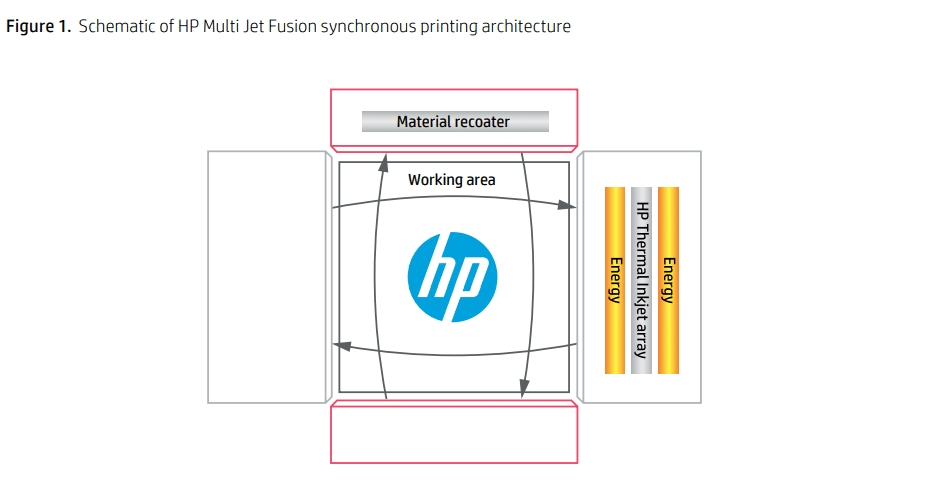
Developed by HP, MJF is a high-speed industrial 3D printing process.
How MJF Works
A print head deposits a fusing agent onto a nylon powder bed. Then, an infrared energy source passes over, melting the areas with the agent. A detailing agent is used to control edge definition. The build platform lowers, a new powder layer spreads, and the cycle repeats.
Unlike SLS, MJF uses inkjet-style printing to define the part, enabling faster processing.
Benefits of MJF
- Speed: Up to 10x faster than traditional SLS
- Consistency: Uniform mechanical properties across the build
- Surface Finish: Smoother than SLS, with fine detail
- Cost-Effective: For medium to large production runs
MJF is widely used in manufacturing for functional parts like housings, brackets, and fluid connectors.
Common MJF Applications
- Automotive Components: Durable under stress and heat
- Medical Devices: Custom housings and surgical tools
- Consumer Products: Complex assemblies with tight tolerances
MJF bridges the gap between prototyping and production.
Direct Metal Laser Sintering (DMLS)
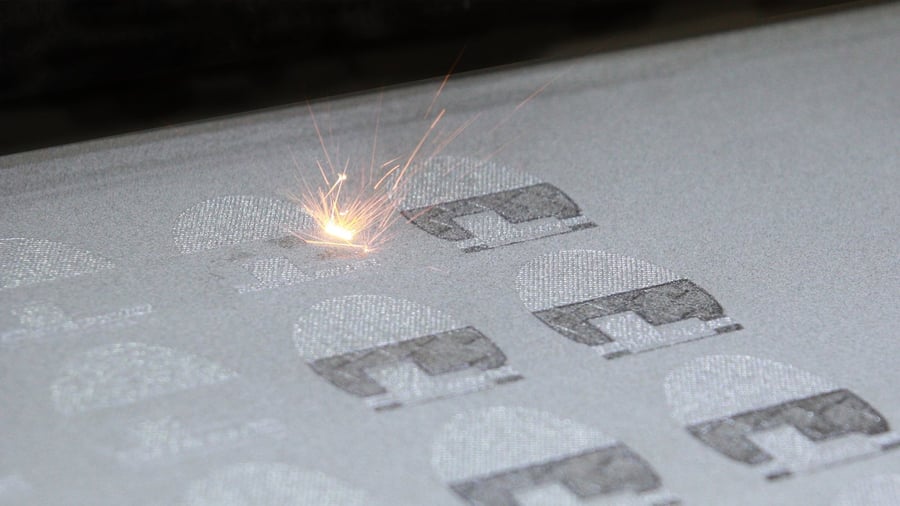
For metal parts, DMLS is one of the most widely used industrial 3D printing methods.
How DMLS Works
Similar to SLS, but with metal powder. A high-powered laser fuses fine metal particles layer by layer in an inert gas chamber. Common materials include stainless steel, titanium, and aluminum.
The process allows for highly complex metal geometries impossible with traditional machining.
Metals Used in DMLS
- Stainless Steel 17-4 PH: High strength and corrosion resistance
- Titanium Ti6Al4V: Lightweight and biocompatible, ideal for aerospace and medical
- Aluminum AlSi10Mg: Lightweight with good thermal properties
- Inconel 718: Resists extreme heat and pressure
DMLS is critical in industries where performance and weight are critical.
DMLS vs. Traditional Machining
- Design Freedom: DMLS enables internal channels and lattice structures
- Waste Reduction: Additive process uses only necessary material
- Lead Time: Faster for complex parts, with no tooling required
However, DMLS parts often require post-processing like heat treatment or CNC finishing.
Electron Beam Melting (EBM)
EBM uses an electron beam instead of a laser to melt metal powder, operating in a vacuum.
How EBM Differs from DMLS
- Energy Source: Electron beam with high power and fast scanning
- Environment: Vacuum chamber prevents oxidation
- Temperature: Build chamber is preheated, reducing residual stress
- Materials: Primarily titanium and cobalt-chrome alloys
EBM is slower to set up but excels in producing dense, strong metal parts.
EBM in Aerospace and Medical
- Aircraft Components: Lightweight, high-strength parts
- Orthopedic Implants: Porous structures that bond with bone
Due to high equipment costs, EBM is mostly used in specialized industrial settings.
Surface Finish and Post-Processing
EBM parts have a rougher surface than DMLS and often require machining or polishing. However, the internal density and mechanical strength are exceptional.
Bioprinting and Emerging Types
Beyond plastics and metals, new 3D printing technologies are pushing boundaries.
What Is Bioprinting?
Bioprinting uses living cells as “bio-ink” to create tissue-like structures. A print head deposits cell-laden hydrogels in precise patterns, mimicking natural tissue architecture.
Current applications include:
– Drug Testing: 3D-printed tissues for pharmaceutical research
– Tissue Engineering: Skin, cartilage, and vascular structures
– Organ Research: Experimental models of kidneys and hearts
While full organ printing is still years away, progress is accelerating.
Other Emerging Technologies
- Binder Jetting: Sprays adhesive onto sand or metal powder, used for molds and full-color prints
- Cold Spray Additive Manufacturing: Projects metal particles at high speed to build up material, used in repair and aerospace
- Large-Scale Construction Printing: Concrete extrusion for building homes and structures
These technologies are expanding 3D printing into entirely new industries.
Frequently Asked Questions About 3D Printer Types
What is the most common type of 3D printer for beginners?
FDM (Fused Deposition Modeling) is the most common and beginner-friendly. It’s affordable, easy to maintain, and works with widely available filaments like PLA and PETG.
Which 3D printer type offers the highest detail?
SLA and DLP printers offer the highest detail. SLA can achieve resolutions as low as 25 microns, while DLP cures entire layers at once for consistent detail across small parts.
Can 3D printers print metal parts?
Yes. DMLS and EBM are industrial 3D printing methods specifically for metal. DMLS uses a laser to fuse metal powders like stainless steel and titanium, while EBM uses an electron beam in a vacuum.
What is the difference between SLA and DLP?
SLA uses a focused UV laser to cure resin point by point. DLP uses a pixelated UV projector to cure entire layers at once. DLP is often faster, while SLA can achieve slightly finer detail.
Are SLS 3D printers available for small businesses?
Yes. Desktop SLS printers like the Formlabs Fuse 1 have made this technology more accessible to small businesses and labs, though they still require careful powder handling.
What is bioprinting used for?
Bioprinting is used to create tissue-like structures from living cells. Current applications include drug testing, tissue engineering for skin and cartilage, and experimental organ research models.
Key Takeaways for Choosing the Right 3D Printer Type
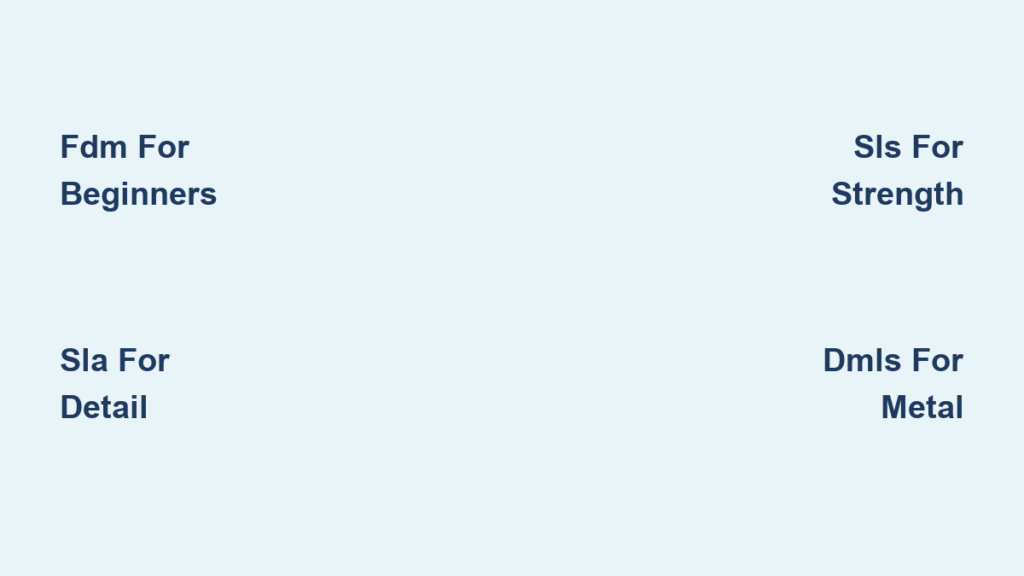
Understanding the different 3D printer types helps you match the right technology to your project. FDM is the best starting point for beginners due to its low cost and simplicity. SLA and DLP deliver unmatched detail for miniatures, jewelry, and dental work. SLS and MJF produce strong, functional parts for prototyping and low-volume production. DMLS and EBM handle metal components for aerospace, automotive, and medical applications. Emerging technologies like bioprinting and binder jetting are opening new possibilities in medicine and construction.
Your next step: identify your primary goal, whether it’s detailed miniatures, functional prototypes, or metal parts, and start researching specific models within that 3D printer type. A clear purpose will save you money and frustration as you choose the right machine.


